
Horizontal Mounting Derating Rules for DIN Rail Power Supplies
The Page Answer in One Minute
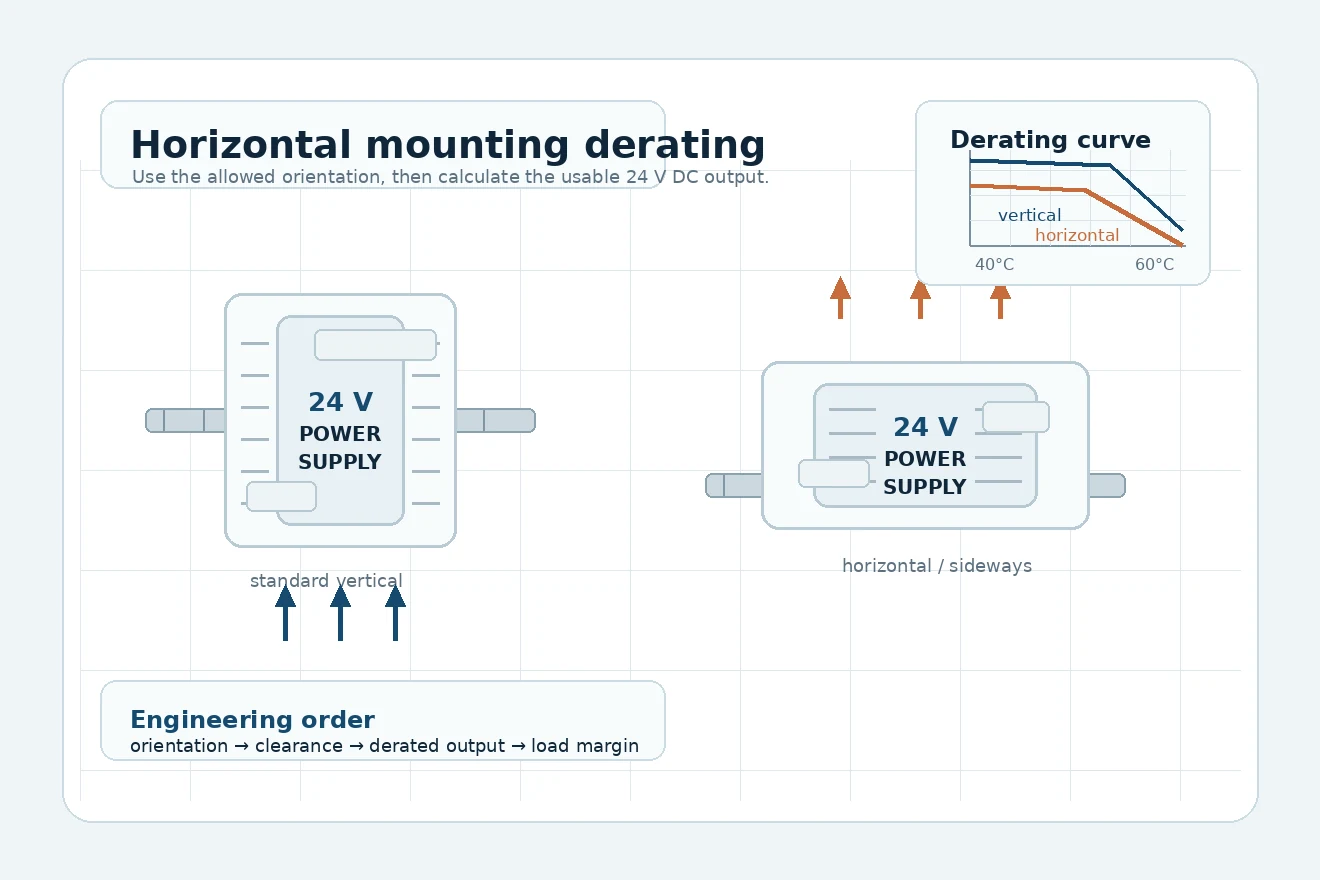
A DIN rail power supply is normally cooled by natural convection. Its housing, vents and internal heat path are usually designed around a stated mounting position. When the unit is turned sideways or mounted horizontally, warm air may no longer leave the supply in the same way.
The correct engineering sequence is simple: confirm the allowed orientation, check the clearances, read the orientation derating curve, calculate the remaining watts or amps, then compare that value with the real 24 V DC load in the cabinet.
Rules of thumb are useful only as a warning. They are not a replacement for the installation manual, because one manufacturer may provide a horizontal curve, another may give a fixed reduction, and another may state vertical mounting only.
What the documentation says
| Finding | Action |
|---|---|
| Horizontal mounting allowed with a curve | Use the curve at the cabinet ambient near the supply. |
| Other orientations allowed with a fixed reduction | Apply the reduction and document the remaining output. |
| Only vertical mounting shown | Treat horizontal mounting as unsupported until proven otherwise. |
| Horizontal mounting prohibited | Change the layout or select a different approved supply. |
Why Horizontal Mounting Changes the Rating
The output label on a DIN rail supply is tied to stated operating conditions. Orientation is one of those conditions when the manufacturer defines a normal mounting position or gives separate derating data for other positions.
In a vertical installation, warm air can rise through and around the housing in the direction expected by the design. A horizontal position can interrupt that path, trap heat beside internal components or push warm air toward terminals and cable ducts.
The result is not always immediate failure. More often it is reduced continuous output margin, earlier thermal protection, shorter component life, DC OK alarms under load or faults that appear only after the cabinet has warmed up.
Manufacturer Data: What Usually Exists
| Source pattern | Useful data | How to apply it |
|---|---|---|
| PULS selection guidance | Horizontal installation can impair airflow and may require derating. | Use the exact product datasheet and any approved mounting accessory before changing orientation. |
| PULS orientation curves | Some product data gives output-current curves for alternative orientations. | Read the curve for the installed position, not only the nameplate current. |
| Delta horizontal derating example | A 240 W CliQ II example gives horizontal derating above 40 °C at 2.5% per °C. | Use the stated start temperature and slope only for the model family that publishes it. |
| Phoenix Contact product data | Product data can specify mounting position, spacing and clearance requirements. | Do not calculate output margin until the real cabinet clearance is known. |
| Vertical-only manual example | Some manuals state that horizontal or upside-down mounting is not allowed. | Do not invent a derating factor. Reposition the supply or select a model approved for the layout. |
Series Examples: How Horizontal Mounting Rules Differ
| Series or example | What the data says | How to read it in a cabinet |
|---|---|---|
| Delta CliQ III 24 V / 240 W class | Horizontal mounting derating starts above 40 °C, with power reduced by 2.5% per °C in the example datasheet. | A 240 W supply is not automatically a 240 W supply when mounted horizontally in a warm enclosure. At 55 °C, the usable output can be much lower than the nameplate rating. |
| Delta CliQ II 240 W class | The datasheet separates vertical and horizontal mounting curves, with horizontal operation derating earlier than normal vertical mounting. | The mounting position changes the thermal limit. Use the horizontal curve, not the vertical curve, when the unit is rotated. |
| PULS compact DIN rail supplies | Horizontal installation can impair airflow, and derating may be necessary when the supply cannot be installed in its standard vertical orientation. | Treat horizontal mounting as a thermal design condition. Check whether the selected model gives an orientation curve, a reduced current limit or a lower maximum ambient temperature. |
| Moxa HDR-60-24 type installation | The installation guide allows vertical mounting only and states that horizontal, upside-down or table-top mounting is not allowed. | No derating calculation solves a forbidden orientation. The cabinet layout or supply selection must change. |
| Small enclosed 24 V DIN rail supplies | Some series specify larger clearances for horizontal mounting or warn that the enclosure can become hot under load. | Clearance is part of the rating. A supply squeezed against wiring duct, relays or another heat source may fail the installation condition even if the load current seems acceptable. |
Horizontal Mounting Derating Calculator
Use this calculator to read a datasheet derating curve. Enter the rated output, the cabinet ambient temperature at the power supply, the temperature where the horizontal curve starts to derate, and the reduction rate from the manufacturer data.
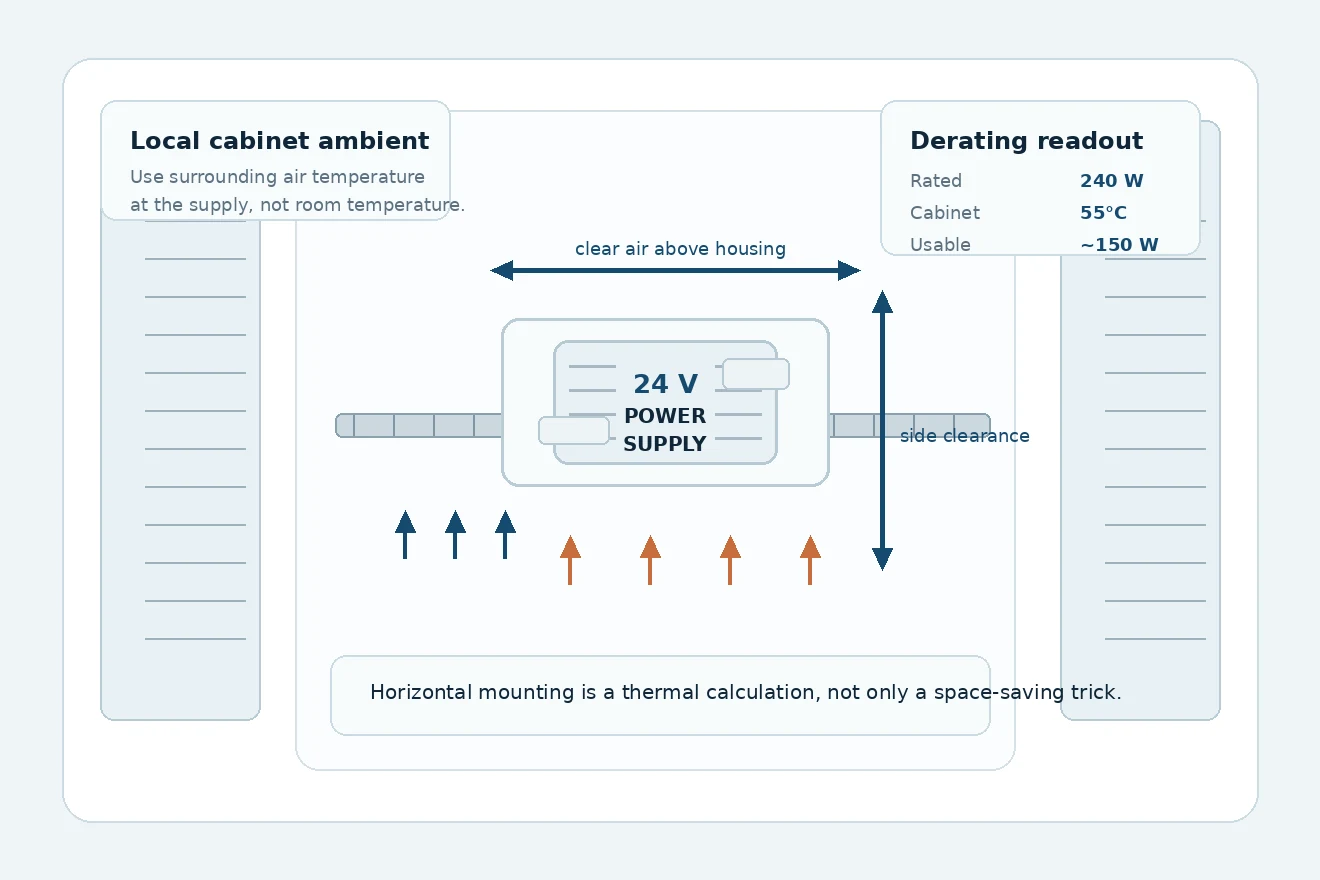
The default example uses a 240 W, 24 V supply with horizontal derating above 40 °C at 2.5% per °C. At 55 °C, the remaining output is about 150 W, or about 6.25 A at 24 V DC.
Worked Example: 240 W Supply at 55 °C
| Step | Value | Result |
|---|---|---|
| Rated output | 240 W at 24 V DC | Nameplate current is 10 A before derating. |
| Horizontal curve starts | 40 °C | No reduction below this point in the example curve. |
| Cabinet ambient at supply | 55 °C | 15 °C above the horizontal derating start. |
| Reduction rate | 2.5% per °C | 15 × 2.5% = 37.5% reduction. |
| Remaining output | 62.5% of 240 W | 150 W available for continuous load. |
| Remaining current | 150 W ÷ 24 V | About 6.25 A before any additional design margin. |
Load Budget After Derating
| Load group | What to count | Why it changes the decision |
|---|---|---|
| PLC and I/O | CPU, digital modules, analogue modules and any module-fed field devices. | The permanent control load may be larger than the CPU label suggests. |
| HMI and network devices | HMI, switch, gateway, router, remote I/O adapter. | These loads often reset first when the rail dips. |
| Sensors and field devices | Continuous sensor current plus simultaneously active devices. | Many small field loads can consume the derated margin quietly. |
| Relay and contactor coils | Holding current and pull-in demand during the operating sequence. | Short peaks can trip or sag a thermally marginal supply. |
| Spare capacity | Documented reserve, not an unlimited spare allowance. | After horizontal derating, spare capacity can disappear completely. |
Inspection Sequence for a Horizontal Installation
| Step | Evidence to collect | Decision |
|---|---|---|
| 1. Identify the exact supply | Manufacturer, part number, output rating and document revision. | Use data for the installed model, not a similar-looking unit. |
| 2. Confirm orientation permission | Installation manual, datasheet, accessory notes or manufacturer statement. | If the position is not permitted, change the layout or the supply. |
| 3. Check clearances | Top, bottom, side clearance, cable duct distance and nearby heat sources. | Blocked airflow can make a permitted position unsuitable. |
| 4. Measure local ambient | Temperature beside the supply after the cabinet has warmed up. | Use this value for the curve, not room temperature. |
| 5. Calculate derated output | Remaining watts or amps from the manufacturer rule. | This is the usable continuous supply capacity. |
| 6. Compare the load | Measured continuous current, known peaks and backed-up loads. | The cabinet needs margin after derating, not only a pass at idle. |
Design Options When the Number Is Too Low
| Option | When it helps | What still needs checking |
|---|---|---|
| Move the supply to a vertical position | The cabinet has another rail position with better natural airflow. | Input routing, output routing, service access and separation from heat sources. |
| Use a supply approved for side mounting | The enclosure is shallow or the DIN rail layout cannot be changed easily. | The exact accessory, curve, clearance and model-specific rating. |
| Select a larger or higher-temperature supply | The derated output is close to the real load. | Branch protection, conductor sizing, fault-current capability and heat produced by the larger unit. |
| Split the 24 V load | One supply is thermally marginal or noisy loads disturb sensitive devices. | Common reference, protection selectivity, diagnostics and shutdown behaviour. |
| Improve enclosure ventilation | The orientation is permitted and local ambient temperature is the limiting factor. | Filter condition, airflow path, fan failure behaviour and actual temperature at the supply. |
Faults That Point Back to Orientation and Heat
Common Mistakes
| Mistake | Why it fails | Better check |
|---|---|---|
| Using only the nameplate current | The label does not cover every orientation and enclosure temperature. | Use the derated output for the actual mounting position. |
| Copying a forum percentage | The correct curve depends on housing design, product family and cooling path. | Use the model-specific datasheet or installation manual. |
| Ignoring cable ducts | Duct walls can block the airflow that the curve assumes. | Check clearance after the cabinet is fully wired. |
| Using room temperature | The air at the supply may be much warmer than the room. | Measure near the supply after warm-up. |
| Oversizing without protection review | A larger supply can change available fault current and branch-protection needs. | Review conductor size, fusing, electronic protection and load grouping. |
Related Reading
Common Questions
Can a DIN rail power supply be mounted horizontally?
Only when the manufacturer documentation allows that orientation. If the manual allows only vertical mounting, a derating calculation is not a substitute for an approved installation position.
Why does horizontal mounting require derating?
Horizontal mounting can disturb the intended convection path through the housing. Less effective cooling raises internal component temperature, so the continuous output power or allowed ambient temperature may need to be reduced.
Is there one derating percentage for all DIN rail power supplies?
No. Some datasheets give an orientation-specific curve, some give a fixed reduction, and some prohibit horizontal mounting. The product datasheet or installation manual controls the decision.
How do I calculate horizontal mounting derating?
Use the rated output, the cabinet ambient temperature at the supply, the derating start temperature and the reduction rate from the manufacturer curve. The remaining output is then compared with the real continuous 24 V load.
Does a 240 W supply still deliver 240 W when mounted sideways?
Not automatically. A 240 W label is valid under the stated mounting and temperature conditions. In another orientation or a hot cabinet, the usable continuous output may be lower.
What if the datasheet has no horizontal mounting curve?
Treat the orientation as unproven. Check the installation manual, product accessories and manufacturer guidance before using the device horizontally in a cabinet.
Can extra ventilation remove the need for derating?
Better ventilation can lower the surrounding air temperature at the supply, but it does not override a manufacturer orientation limit. The installation still has to match the allowed mounting position and clearances.
When is a larger power supply the wrong fix?
A larger supply is the wrong fix if the selected model is still not approved for the installed orientation, if branch protection becomes unsuitable, or if the cabinet still traps heat around the supply.