
Control Cabinet Protection Library
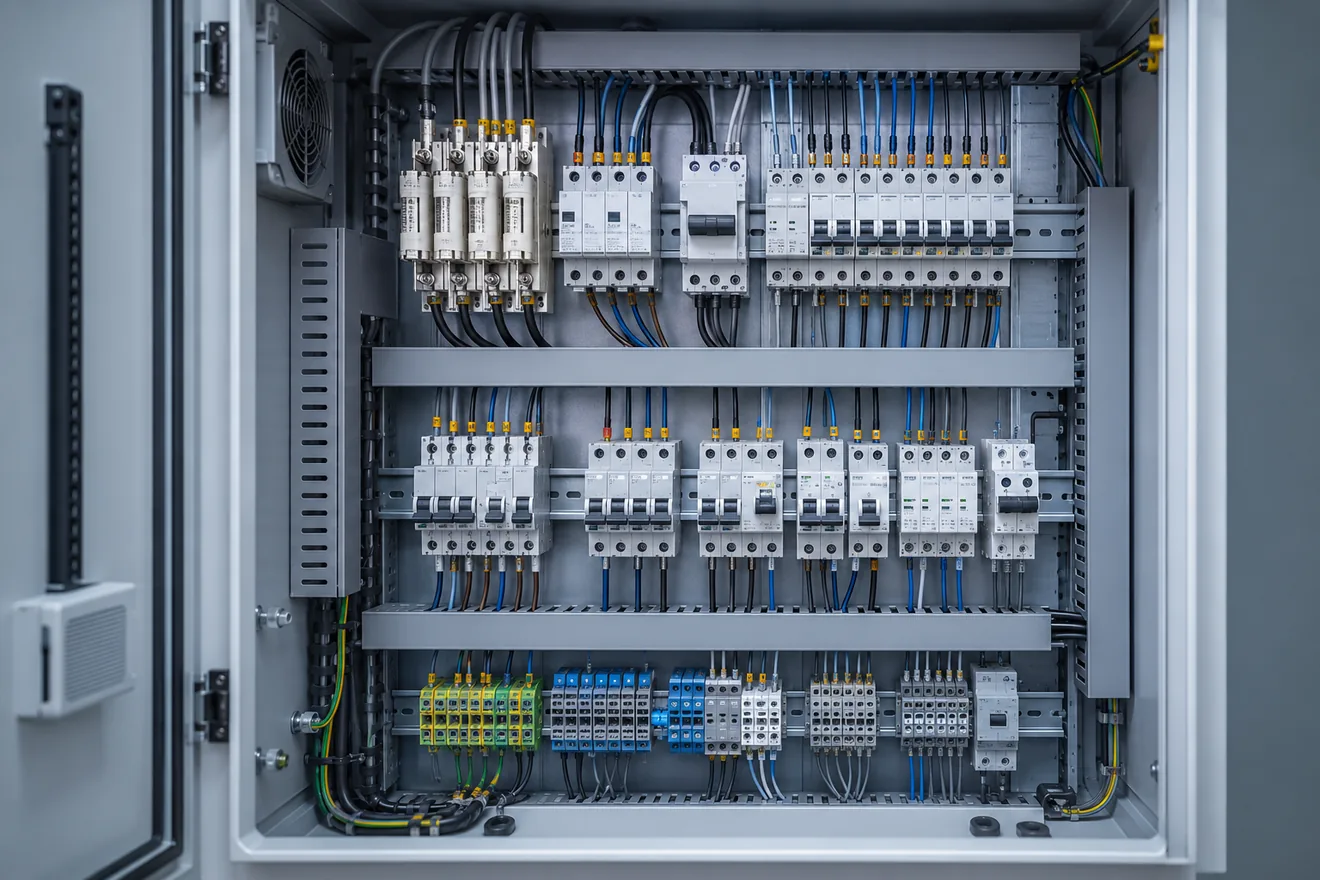
What the Protection Section Must Prove
The protection section is the part of the cabinet that limits damage when current, temperature or insulation condition moves outside the intended operating range.
A useful review separates the protective device, the cable it protects, the load behaviour and the fault evidence left in the cabinet. This avoids treating a blown fuse or a tripped breaker as the cause when it is only the visible result.
The critical question is whether the installed protection matches the available fault current, conductor size, load duty, starting behaviour and service conditions inside the enclosure.
Protection Library
Fuse vs Circuit Breaker in a Control Panel
Compare fuses and circuit breakers by fault current, reset behaviour, selectivity, heat, holder condition and service checks.
Read page24 V DC MCBs and Electronic Circuit Protectors
See why long 24 V DC cable runs can keep an MCB out of its fast trip region, and how electronic protectors isolate the faulted branch.
Read page24 V DC Electronic Circuit Breakers
See how electronic circuit breakers isolate a faulted 24 V DC branch before it pulls down PLC, I/O, sensor or HMI loads on the common bus.
Read pageFloating 24 VDC: Fuse Positive & Negative?
See how grounded and floating 24 VDC circuits differ, why both ungrounded conductors may need protection, and how first and second earth faults change the fault path.
Read pageTypical Protection Fault Evidence
A protective device normally operates because the circuit asks it to operate. Evidence can include trip timing, fuse condition, load state, terminal discoloration, overheated insulation, damaged holders, nuisance tripping during start or a fault that appears only after the cabinet warms up.
Evidence should be collected in order: fault type, available supply, device rating, conductor size, load current, inrush behaviour, terminal condition, cabinet temperature and the exact point where voltage or insulation fails.
Protection Checks by Function
| Function | What to check | Common evidence |
|---|---|---|
| Fault type | Separate overload, short circuit, inrush, earth fault and thermal operation before choosing the next test. | The device operates only at start, only under load, immediately on energising or only after warming. |
| Protective device | Fuse class, breaker curve, rated current, breaking capacity, trip history and suitability for the circuit duty. | The device is intact but mismatched, aged, overheated or repeatedly operated outside the intended duty. |
| Cable and terminals | Conductor size, insulation condition, terminal pressure, holder condition, heat marks and branch routing. | Local discoloration, brittle insulation, loose terminals or voltage loss near the protected branch. |
| Load behaviour | Running current, starting current, duty cycle, mechanical load, motor condition, solenoid state and field wiring. | Trips appear when a motor starts, a solenoid pulls in, a heater cycles or a damaged cable is moved. |
Common Questions
What should be checked first after a fuse blows or breaker trips?
Classify the fault condition first, then check load current, short-circuit evidence, inrush timing, terminal heat, cable condition and device duty before replacing parts.
Why can a protective device operate repeatedly without being faulty?
Repeated operation can come from overload, high inrush, poor coordination, loose terminals, heat, damaged cable insulation, a failing load or an upstream fault condition.