
Control Cabinet Isolation Library
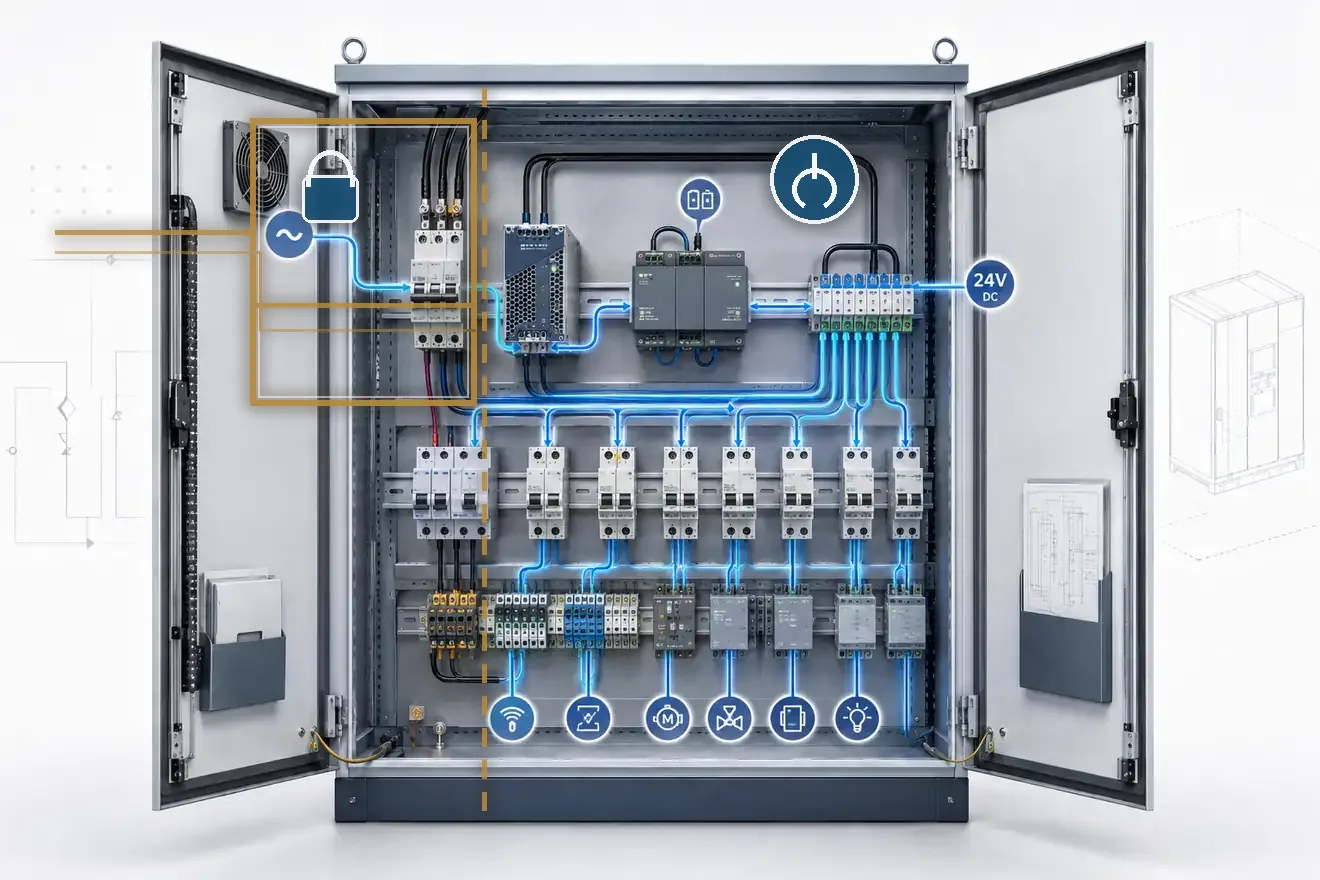
What the Isolation Section Must Prove
The isolation section is the part of the cabinet that defines where electrical energy is disconnected for inspection, maintenance or fault work.
A useful review separates the incoming terminals, the switching device, the mechanical handle, downstream circuits and any auxiliary supply. This avoids treating a handle marked off as proof that every terminal inside the enclosure is dead.
The critical question is whether the selected device creates a clear, lockable and understandable off state for the part of the cabinet where work is taking place.
Isolation Library
Main Switch vs Isolator
Understand the difference between a cabinet main switch and an isolator, where each is used and what must be checked before relying on the off position.
Read pageLoad-Break vs Non-Load-Break
See why a load-break switch can be opened under rated load, while an isolation-only device must not be used as an everyday switching point.
Read pageMain Disconnect OFF: What Can Still Be Live?
See which incoming terminals, auxiliary supplies, UPS circuits, external control feeds and stored-energy components may remain energised after the main disconnect is switched off.
Read pageCan a Contactor Be Used for Electrical Isolation?
See when a contactor is only a switching device, when a specific model may be suitable for isolation and what must still be verified before maintenance work.
Read pageTypical Isolation Fault Evidence
An unsafe off state is often found through evidence rather than through the front handle alone. Examples include live auxiliary terminals, backfed control voltage, a handle that does not clearly drive the switching device, or a circuit that remains energised through a UPS or external signal.
Evidence should be collected in order: incoming condition, device rating, contact position, lockable mechanism, door interlock action, labels, neutral and control circuits, stored energy and voltage at the actual work point.
Isolation Checks by Function
| Function | What to check | Common evidence |
|---|---|---|
| Incoming side | Supply terminals, upstream protection, neutral arrangement and any exposed live point before the isolating device. | Incoming terminals remain live even when the cabinet handle is off. |
| Switching device | Rated voltage, current, utilisation category, number of poles, short-circuit coordination and suitability for load breaking. | The installed device disconnects, but is not suitable for the duty expected from it. |
| Handle and access | Door coupling, lockable off position, clear indication, access route and whether the door can be opened in the intended state. | The handle position is unclear, the mechanism is loose or the door can be opened without a clear isolation step. |
| Remaining live circuits | UPS feeds, cabinet lights, sockets, heaters, network equipment, remote I/O, external signals and backfeed paths. | One section is isolated while control or auxiliary circuits still carry voltage. |
Common Questions
What should be checked first in a cabinet isolation review?
Identify the real isolation boundary, then check what the device disconnects, whether it is rated for the switching duty, whether the off position is lockable and what circuits may remain live.
Can a cabinet still contain live circuits after the main switch is off?
Yes. External signals, UPS-backed supplies, lighting, socket circuits, network equipment, interlocks and incoming terminals can remain live depending on the cabinet design and wiring.