Power in Control Cabinets
What the Power Section Must Prove
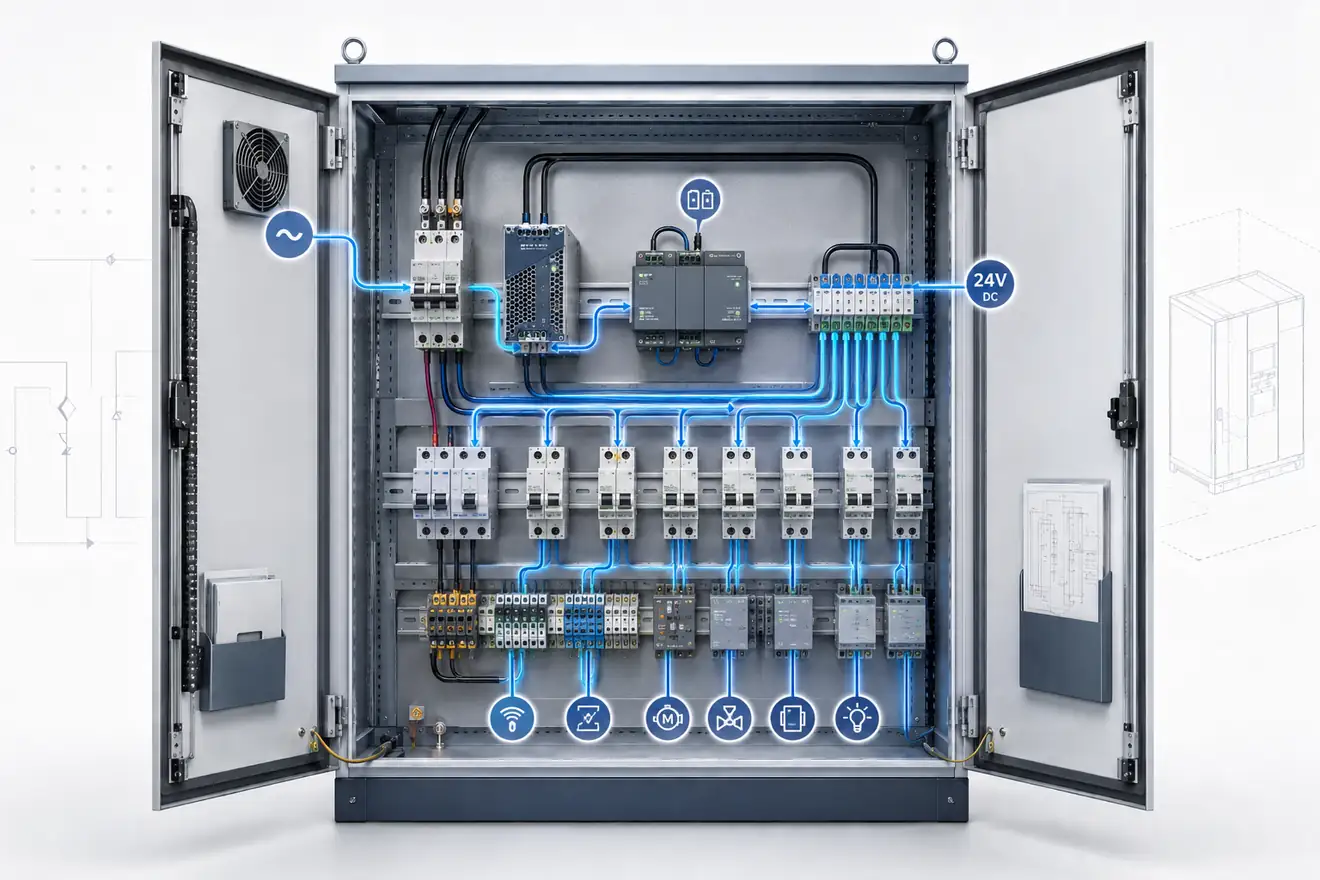
The power section is the complete path that carries energy from the incoming terminals to devices that require stable control voltage.
A useful inspection separates the source, conversion stage, distribution branches and field loads. This avoids replacing a power supply when the real cause is voltage drop, inrush current, a loose terminal, poor cooling or a changed load.
The critical question is whether the circuit provides the required voltage at the load terminals while the machine or process is actually operating.
Power Topics
24 V DC Power Supply
Output voltage, load margin, voltage drop, DC OK contacts and overload symptoms in cabinet power circuits.
Read pageHorizontal Mounting Derating
How orientation, cabinet temperature and airflow change the usable output of a DIN rail power supply.
Read pageParallel 24 V DC Power Supplies
How to distinguish added output capacity from real redundancy, verify load sharing and trace common fault points.
Read page24 V DC from 400 V Without Neutral
How to obtain 24 V DC from a 400 V three-phase supply without neutral using line-to-line or three-phase PSU input.
Read pageTypical Power Fault Evidence
Low control voltage is a symptom, not a diagnosis. PLC faults, sensor errors, contactor chatter and communication drops can all appear when the DC rail sags briefly.
Evidence should be collected in order: input voltage, output voltage, ripple, load current, terminal temperature, branch protection, cable length and fault timing. A drop during machine start is different from a slow loss after the cabinet warms up.
Power Checks by Function
| Function | What to check | Common evidence |
|---|---|---|
| Incoming supply | Voltage, phase condition, upstream protection and terminal condition. | No input, low input, heated terminal, intermittent supply. |
| Power supply | Rated current, derating, cooling space, output voltage and DC OK state. | Rail drops under load, LED alarm, unstable output. |
| Distribution | Branch protection, terminal blocks, conductor size and cable routing. | One branch fails, voltage differs between points, local heating. |
| Loads | Real current, inrush, duty cycle, device condition and wiring distance. | Fault appears only during start, switching or warm operation. |
Common Questions
What should be checked first in a cabinet power fault?
Check the incoming supply, power supply input, DC output, load current, distribution branches, terminals and voltage at the load.
Why does a 24 V DC rail drop under load?
Common causes include undersized conductors, long cable runs, high inrush, loose terminals, overload, weak buffer modules and aged connectors.