
Parallel 24 V DC Power Supplies: Redundancy, Load Sharing and Fault Isolation
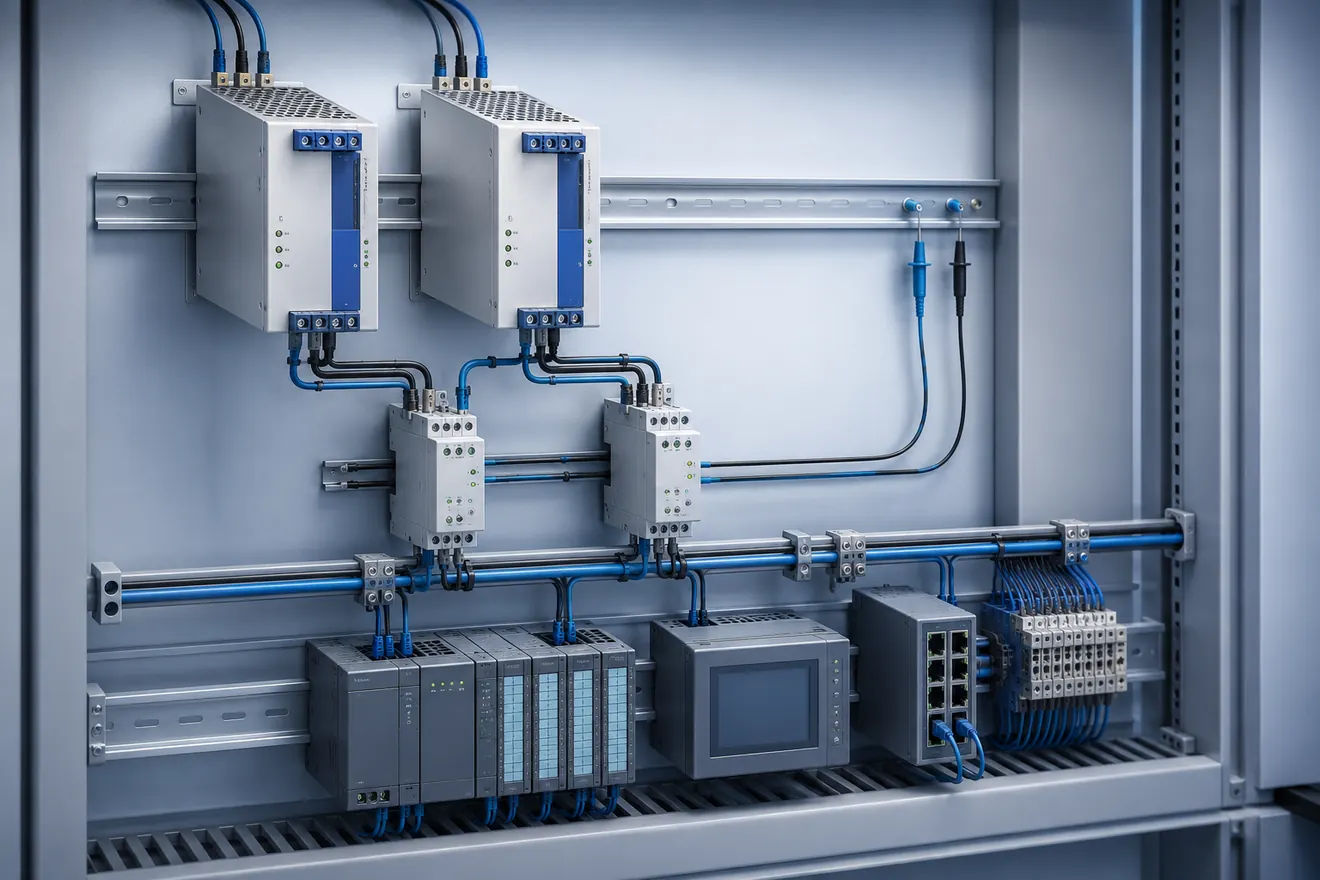
The Page Answer in One Minute
Parallel operation, decoupling, load sharing and redundancy are related but separate functions. Two supplies may be connected to increase available current without surviving the loss of either one. A diode or MOSFET module may isolate a failed output without making the two supplies share current equally.
For a 1+1 arrangement, use the derated continuous capacity of one supply as the reference. The combined rating of both units is not the proof. A pair of 10 A supplies can provide 20 A of parallel capacity only when both supplies, the decoupling stage and the wiring are approved for parallel operation. It is still not 1+1 redundancy for a 15 A critical rail.
The next question is fault coverage. Two DC outputs may be redundant while a shared AC protective device, common terminal, common redundancy module or common downstream short still removes the complete rail.
What the arrangement proves
| Arrangement | What it can prove | What it does not prove |
|---|---|---|
| Two supplies approved for parallel operation | More capacity when both supplies remain healthy. | Survival of one supply failure. |
| Two decoupled 10 A supplies on a 10 A critical rail | Potential 1+1 DC conversion redundancy. | Protection from a common AC or downstream fault. |
| One supply hot, one near idle | Both units may still be live. | Balanced loading or equal ageing. |
| Two supplies supplied through one AC breaker | Potential DC-conversion redundancy if one supply fails internally. | Redundant primary feed or breaker path. |
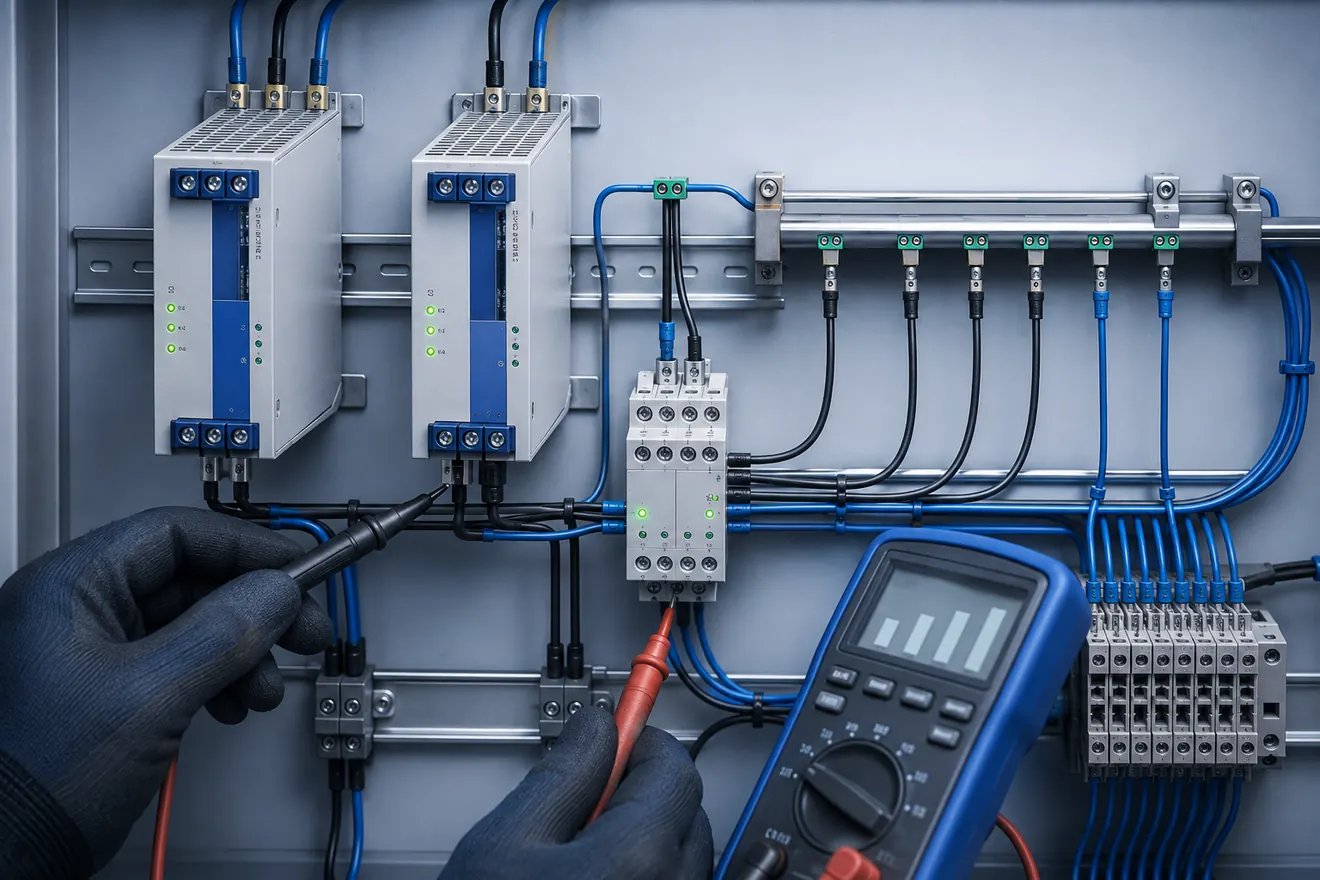
Four Functions That Must Not Be Mixed
Parallel operation combines supplies to increase available output current. Decoupling prevents one failed output from being fed backwards by the healthy path. Load sharing aims to divide normal current between supplies. Redundancy means the critical load remains supplied after a defined single fault.
They may exist in the same cabinet, but one does not guarantee the others. The correct inspection starts by naming which function is required, then proving it with load data, output measurements and a trace of the common points.
Parallel Capacity, 1+1 and N+1
| Mode | Typical arrangement | Capacity test after one supply is lost | What must be documented |
|---|---|---|---|
| Parallel capacity | 2 × 10 A supplies feeding a 15 A rail. | Only 10 A remains: the remaining supply cannot carry the full 15 A rail load. | Parallel permission, current-sharing behaviour and combined branch capacity. |
| 1+1 redundancy | 2 × 10 A supplies feeding a critical rail of 10 A or less. | One 10 A supply remains capable of carrying the protected load. | Derating, decoupling, common points and the stated fault coverage. |
| N+1 redundancy | 3 × 10 A supplies feeding a critical rail of up to 20 A. | Two 10 A supplies remain and can support 20 A, provided their installed derated capacity allows it. | Per-unit capacity at installed conditions, module current rating, fault isolation and stated fault coverage. |
| Cold standby | One supply normally carries the rail; another is switched or held in reserve. | Depends on transfer logic and permitted interruption time. | Changeover path, test routine, inrush during takeover and alarm coverage. |
Why One Supply Carries Most of the Current
Unequal current is not automatically a loss of redundancy. A 1+1 pair can still survive a failure when either unit has enough capacity for the critical rail. But a permanently leading supply runs warmer, ages faster and may be much closer to its limit than the status LEDs suggest.
Use identical or explicitly compatible supplies where possible. Match their approved operating mode, output setting, conductor length and conductor cross-section between the supplies and the decoupling point. Then measure the current in each positive output conductor under the real machine duty cycle.
A green LED is not load sharing
| Observation | Likely reading | Next check |
|---|---|---|
| Supply A is hot; Supply B is cool. | Current may be concentrated in A. | Measure current in each DC output path. |
| Both DC OK contacts are healthy. | Both outputs are in range. | Compare their actual current and rail voltage. |
| One output is 24.3 V; the other is 24.0 V before connection. | The higher setting may lead. | Use the documented matching procedure before paralleling. |
| Current changes sharply after a terminal is tightened. | Path resistance was influencing the share. | Inspect terminals, conductor size and route symmetry. |
Diode and MOSFET Decoupling: Voltage Drop and Heat
Every decoupling path has some voltage drop. At high current, that drop becomes heat inside the cabinet and reduces the voltage available to the rail. Diode modules are simple and robust, but the voltage loss can be material. MOSFET-based modules typically reduce the drop, but their fault behaviour, monitoring and balancing capability remain model-specific.
Use the values published for the installed module at the measured current and temperature. The check below is only a physical conversion of that measured voltage drop into path voltage and heat loss.
What a Redundancy Module Does — and Does Not Do
| Condition | Can an ORing or redundancy module help? | What still has to be proven |
|---|---|---|
| One supply output collapses or would otherwise draw reverse current. | Yes, where the specific module is rated to block reverse current for that fault. | The healthy supply can carry the critical load after the event. |
| One supply path loses AC input. | Usually yes for the DC supply stage, if the other path remains healthy. | The remaining AC path and its supply stay available. |
| Current is uneven in normal operation. | Only if the selected system includes defined active balancing. | Balancing range, compatible supplies and wiring symmetry. |
| One downstream branch develops a short circuit. | Not by itself. The common DC rail can still be pulled down. | Branch protection, selectivity and the fault response of the supplies. |
| A shared output terminal or the single redundancy module itself fails. | Not by itself. A shared output stage can interrupt both paths. | Terminal condition, module fault behaviour, conductor support and inspection access. |
| Both supplies are fed through one upstream breaker. | No. The breaker remains a common cause. | Which upstream faults the system is expected to survive. |
Inspection Sequence: Prove the Backup Before It Is Needed
| Step | Evidence to collect | What the evidence answers |
|---|---|---|
| 1. Define the protected load | List the PLC, safety-related controls, communication equipment and any loads that must stay live. | What current must remain after one path is lost? |
| 2. Read each supply at installed conditions | Model, approved parallel mode, rated current, cabinet temperature and derating data. | Can either unit carry the critical rail on its own? |
| 3. Trace common points | AC protective devices, terminals, input feeds, redundancy module, common DC terminals and rail branches. | Which single fault can still remove both paths? |
| 4. Measure each output path | Output voltage before the module, voltage after the module and DC current in each supply conductor. | Are the supplies contributing as expected and is the module loss acceptable? |
| 5. Check the rail at the far load | Voltage at the critical device while the machine is operating. | Does the device receive sufficient voltage after all path losses? |
| 6. Review alarms and test records | DC OK contacts, module diagnostics, past imbalance alarms and approved functional test results. | Will loss of redundancy be noticed before the second fault occurs? |
Proof Test: Verify the Actual Claim
A redundant diagram is only a design intention until the stated fault is tested or otherwise demonstrated. The test must match the claim. A pair supplied through one upstream breaker may prove continued operation after one DC converter path is isolated, but it cannot prove survival of a breaker trip or a shared primary connection fault.
Use a controlled, site-approved test point and the normal documented critical load. The pass condition is not merely that a supply LED stays green. The remaining path has to carry the defined load, each critical device has to stay within its specified supply-voltage range, the process must remain safe and the loss of redundancy must be reported.
Write the claim exactly
Defensible wording: “1+1 redundancy of the 24 V DC conversion stage for the documented critical rail.”
Do not imply: redundant utility supply, redundant upstream protection or protection against any downstream rail fault unless those paths are separately designed and proven.
- Critical load current and operating state
- Current in each positive DC path
- Voltage at the farthest critical load
- Alarm or diagnostic response
- Shared points that remain outside the claim
| Test | Evidence to collect | Pass condition | What it proves |
|---|---|---|---|
| Normal running measurement | Current in path A and path B; voltage before and after decoupling; voltage at the far critical load. | Path currents, voltage loss and load-end voltage are recorded during the real duty cycle. | The starting condition and any imbalance are known before a fault test. |
| Loss of supply path A | Use the approved isolation point for path A; observe the remaining path, critical rail and diagnostics. | Path B carries the full documented critical load without an unplanned reset; the load-end voltage remains within each critical device's specified supply-voltage range; redundancy loss is indicated. | Fault coverage for the specified loss of path A. |
| Loss of supply path B | Repeat the approved test with the opposite path isolated. | Path A carries the full documented critical load under the same operating conditions. | Fault coverage for the specified loss of path B. |
| Common-point review | Trace AC protective devices, terminals, input cables, decoupling connections, common 0 V paths and DC branches. | Every remaining shared point is listed; any shared breaker or terminal narrows the stated fault coverage. | The boundary between DC supply-stage redundancy and independent primary-input redundancy. |
| Downstream branch protection review | Approved coordination evidence, branch-protection settings and prior functional test records. | The documented response shows that a single branch fault is handled as intended without relying on the redundancy module alone. | What the architecture can and cannot do after a downstream fault. |
False Backup Arrangements
Symptom, Physical Cause, Evidence and Action
| Symptom | Physical cause | Evidence / measurement | Action |
|---|---|---|---|
| One supply is hot and one is cool. | Voltage or path-resistance imbalance makes one unit lead. | Measure current in both positive conductors and compare output voltages before and after decoupling. | Check approved parallel mode, settings, cable symmetry and terminal condition. |
| Both supplies show DC OK, but a module alarm reports loss of redundancy. | One path is live but not contributing within the expected range. | Read module diagnostics and verify actual current per path. | Do not clear the alarm without proving capacity after one-path loss. |
| The rail collapses when one supply fails. | The remaining supply is undersized, derated or disconnected from the critical branch. | Compare critical load current with one-supply derated capacity. | Recalculate the protected load and correct architecture or load grouping. |
| Voltage is healthy at supplies but low at the far device. | Loss occurs in the module, branch protection, terminals or conductors. | Measure voltage step by step under operating load. | Locate the drop instead of replacing a healthy supply. |
| Both supplies shut down after one AC disturbance. | A common upstream fault path remains. | Trace incoming feeds, protective devices, terminals and phase arrangement. | State the actual fault coverage or redesign the primary paths. |
Related Reading
Common Questions
Do two 24 V power supplies automatically create redundancy?
No. The arrangement is redundant only for the fault cases it can survive. For 1+1 redundancy, one supply must carry the full critical load after the other supply has failed, and the outputs need suitable decoupling.
Can two power supplies be connected directly in parallel?
Only when the power supply documentation permits parallel operation and the connection method is defined. Directly tying together outputs can create reverse current or poor sharing when the supplies are not designed for it.
Why does one supply carry most of the current?
Small differences in output voltage, cable resistance, terminal resistance or output characteristics can make one supply take the leading share. A green LED on both units does not prove equal loading.
Does a MOSFET redundancy module share the current automatically?
Not necessarily. A MOSFET module primarily reduces voltage drop and decouples the outputs. Equal current sharing needs to be stated as a function of the specific module and compatible supplies.
Is a shared AC miniature circuit breaker a redundant input?
No. A common upstream protective device remains a shared fault point. The DC supply stage may be redundant, but a trip or loose connection upstream can remove both supplies together.
How is 1+1 redundancy checked?
Use the derated continuous capacity of one supply, not the combined nameplate total. That one unit must carry the documented critical load with an appropriate operating margin.
Does a diode module create a voltage loss?
Yes. The drop and heat loss depend on module design, current and temperature. Measure or use the published value at the real load current, then check voltage at the farthest critical device.
Can a redundancy module protect against every 24 V fault?
No. It can isolate one supply path from another, but it does not automatically protect against a common AC loss, a downstream rail short, a shared terminal problem or an undersized critical load budget.
How is a 24 V redundancy arrangement proof-tested?
Use an approved isolation point to test each supply path separately with the documented critical load operating. Record current in the remaining path, voltage at the far critical device and the redundancy alarm response. The test proves only the fault case actually isolated.
Which current should be used to calculate redundancy-module heat?
Use the current through one decoupling path. Under balanced normal operation this is the measured current in that path. During a one-path proof test, use the full documented critical-rail current carried by the remaining path.