
How to Get 24 V DC from 400 V Three-Phase Without Neutral
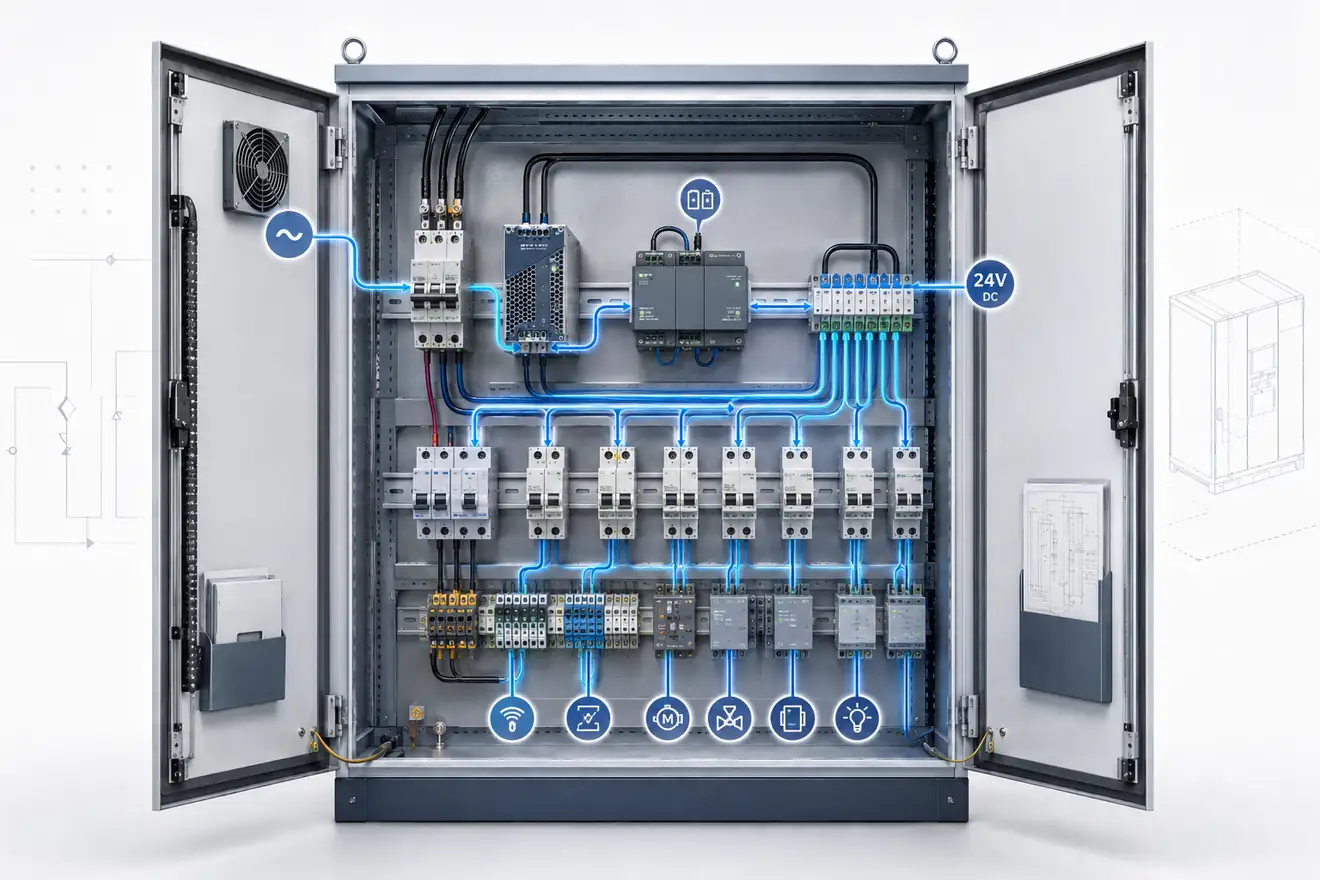
Short Answer
Yes. A 400 V three-phase cabinet without neutral can produce 24 V DC by using either a power supply explicitly rated for 400 V line-to-line input from two lines, or a power supply designed for the full three-phase input.
The important distinction is on the AC side. A 24 V DC output does not tell you what may be connected to the input terminals. A common 230 V-class DIN rail supply may accept only around the normal single-phase mains range, while a dedicated industrial unit can be designed for several hundred volts line-to-line or for all three phases.
For this application, “two-phase” is often used informally. Line-to-line or two-line operation from a three-phase system is clearer: the incoming installation is still a three-phase system.
- Will the PSU use L1–L2 only, or L1–L2–L3?
- Does the selected PSU explicitly accept the measured input voltage?
- Is two-line operation a normal rating or only a derated alternative mode?
- What happens after phase loss?
- Does the available output still cover the real 24 V load at cabinet temperature?
Why 400 V Is Available Without a Neutral
Option 1: Use a Power Supply Rated for 400 V Line-to-Line
Option 2: Use a Three-Phase 24 V Power Supply
Using all three lines spreads the input demand across the three-phase system and is common on higher-power industrial power supplies. It also avoids treating a high-power control load as a permanent load on only one line pair.
The decision is still model-specific. Three-phase input does not automatically mean that the unit will tolerate a missing phase, and phase-loss behaviour should be checked as part of the design.
Alternative: 400/230 V Control Transformer + 230 V PSU
If the cabinet already uses standard 230 V DIN rail power supplies, a 400/230 V control transformer can provide a conventional 230 V supply for the PSU. Control transformers are covered by IEC 61558-2-2; the transformer, primary and secondary protection, earthing and downstream PSU must still be selected for the actual installation.
This approach can be useful where a separate 230 V secondary, an established 230 V control architecture or plant standardisation is required. For the sole purpose of producing 24 V DC, however, a PSU designed directly for 400 V line-to-line or three-phase input is often the simpler cabinet architecture because it avoids the extra transformer, protection devices, wiring, heat and DIN-rail or panel space.
Line-to-Line PSU vs Three-Phase PSU
| Question | 400 V line-to-line PSU | Three-phase PSU |
|---|---|---|
| Input conductors used | Normally two line conductors, for example L1 and L2, plus PE as specified. | L1, L2 and L3, plus PE as specified. |
| Neutral required | No, when the PSU is designed for direct line-to-line input. | Often no, but follow the exact terminal diagram. |
| Best fit | Small to medium 24 V control loads and compact cabinets. | Higher continuous 24 V power and installations that prefer balanced three-phase loading. |
| Loss of one line | The PSU loses its input if either used line is lost. | Model-dependent; some stop, some permit defined two-line operation, sometimes with reduced capability. |
| Selection trap | Assuming any 230 V single-phase PSU can be placed across two 400 V lines. | Assuming every three-phase PSU can run indefinitely on only two lines. |
Can a Normal 230 V DIN Rail PSU Be Connected Between L1 and L2?
Not unless its specified AC input range explicitly includes the line-to-line voltage. A typical 230 V-class supply with an input range such as 85–264 V AC must not be connected across a 400 V line-to-line supply.
This is one of the easiest mistakes to make because the output side still says “24 V DC”. The relevant specification is the input voltage range. If L1–L2 is around 400 V and the maximum permitted input is below that, the unit is outside its rating before the 24 V load is even considered.
Can a Three-Phase PSU Run on Only Two Lines?
Sometimes, but only when the manufacturer specifies two-line operation. A unit that allows it may have different output limits, thermal behaviour, hold-up time, losses or EMC conditions compared with normal three-phase operation.
That distinction matters during both design and fault analysis. A cabinet may appear to continue operating after one line is lost, yet the PSU could now be in a reduced or non-approved operating condition.
For a planned two-line installation, use the published two-line rating. For phase-loss tolerance, check the behaviour specifically documented for the selected model rather than assuming that successful bench operation is an acceptable design condition.
- “2-phase operation”, “two-phase operation” or “operation on two phases”
- allowed line-to-line input range
- maximum continuous output in that mode
- ambient-temperature derating
- hold-up time
- phase-loss response
- approval or EMC notes that differ from normal three-phase operation
What to Look for on the PSU Label or Datasheet
This indicates a supply intended to use two line conductors at the stated line-to-line voltage. Confirm the full operating range and terminal diagram in the datasheet.
This describes normal three-phase input. It does not by itself prove that operation from only L1 and L2 is permitted.
Some three-phase supplies explicitly allow two-line operation. Check the separate two-line input range, output capability, derating, hold-up time and approval notes.
A Practical Selection Path
What Changes with 24 V Load Size?
24 V × 5 A = 120 W
A compact line-to-line rated PSU can be a very practical solution if the input range and cabinet conditions are satisfied.
24 V × 10 A = 240 W
Both architectures can be reasonable. Cabinet temperature, available DIN rail width, plant preference and input protection often decide the choice.
24 V × 20 A = 480 W
A three-phase PSU becomes increasingly attractive for a sustained high-power 24 V rail, especially where balanced input loading is desired.
Input Protection and Cabinet Checks
Use the input fuse, breaker or other protective arrangement required for the selected PSU and conductor sizing. A two-line unit and a three-phase unit may require different arrangements.
Make sure the cabinet isolation strategy disconnects the power-supply input as intended and that any intentionally live auxiliary circuits remain clearly separated and identified.
Connect PE only as specified. It is a protective conductor, not a substitute for neutral and not a normal load-current path.
Check whether the selected PSU is approved for the actual TN, TT or IT supply arrangement and verify its maximum permitted continuous voltage from each input terminal to PE. Corner-grounded delta is a separate case: some industrial PSUs permit it and others explicitly do not.
Do not remove PE connections or alter internal EMC, filter or surge-protection components as a generic solution for an IT or corner-grounded system. Only use a manufacturer-defined configuration where the product documentation explicitly permits it.
After the PSU is selected, verify downstream branch protection, conductor voltage drop, commoning strategy and the behaviour of high-inrush loads.
Common Mistakes
| Mistake | Why it fails | Better check |
|---|---|---|
| Connecting a 230 V PSU across L1–L2 | Line-to-line voltage can be around 400 V, above the PSU input rating. | Read the exact AC input range before wiring. |
| Using PE as a substitute neutral | Protective earth is not intended as the normal return conductor. | Use a PSU architecture that does not require neutral, or provide the correct supply arrangement. |
| Calling L1–L2 a separate “two-phase system” | It obscures the fact that the source is still a three-phase installation. | Describe it as line-to-line or two-line operation. |
| Assuming a 3-phase PSU survives phase loss at full rating | Two-line operation may be unsupported or derated. | Check phase-loss and two-line specifications. |
| Ignoring cabinet temperature | The available 24 V output can be reduced at high ambient temperature. | Use the installed-temperature derating curve. |
| Choosing only by watts | Input protection, inrush, hold-up time, dimensions and fault behaviour can change the practical choice. | Review the complete cabinet power path. |
Related Reading
Common Questions
Can 24 V DC be produced from 400 V three-phase without a neutral?
Yes. Use a power supply explicitly rated either for 400 V line-to-line input from two lines, or for the full three-phase input. A neutral is not required when the selected power supply is designed for that input arrangement.
Can I connect a normal 230 V DIN rail power supply between two 400 V phases?
Only if its specified AC input range explicitly includes the actual line-to-line voltage. A typical 85–264 V AC input supply is not suitable for 400 V line-to-line operation.
Is using L1 and L2 really a two-phase supply?
In this context it is better described as line-to-line or two-line operation from a three-phase system. The cabinet still has a three-phase supply; the power supply simply uses two of its line conductors.
Can a three-phase DIN rail power supply run from only two phases?
Some models can, but not all. Where two-line operation is permitted, output power, thermal limits, hold-up time, losses or EMC conditions may differ from normal three-phase operation.
Do I need neutral for a 400 V three-phase DIN rail power supply?
Not necessarily. Many industrial three-phase power supplies are designed for L1, L2 and L3 plus protective earth and do not use neutral. The terminal diagram and input specification determine the required conductors.
Can protective earth be used instead of neutral?
No. Protective earth is a safety conductor and is not a substitute for a normal load-current return path. Use only the conductors and terminals specified for the power supply and installation.
Which is better for a small 24 V control load: line-to-line or three-phase input?
For a modest control load, a dedicated 400 V line-to-line power supply can be compact and straightforward. For larger continuous loads or where balanced three-phase input is preferred, a three-phase power supply may be the better fit.
What should I check before selecting the power supply?
Confirm the measured system voltage and earthing arrangement, the exact PSU input range, allowed number of input lines, output power at cabinet temperature, phase-loss behaviour, input protection, clearances and the manufacturer wiring diagram.